
Aviation has always demanded self-awareness. For me, understanding my own cognition has become part of understanding safety itself.
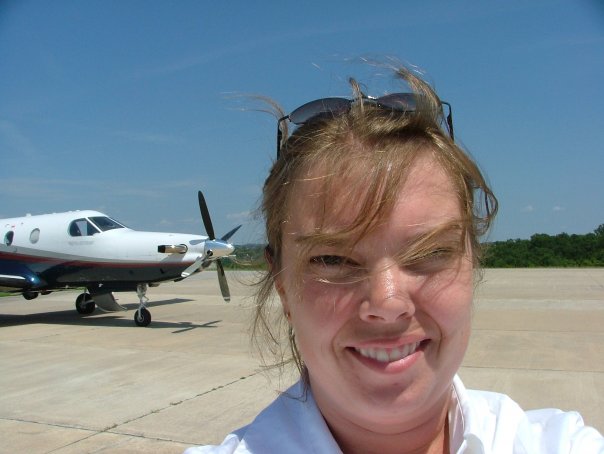
Seventeen years before I was diagnosed with ADHD, I very briefly got to try my dream job: I was a corporate pilot. (And that picture really was me, not Ai!)
As a full-time flight instructor at a busy Part 141 university flight program, I was beginning to burn out on the training scene. I had an empty bank account, a mountain of student debt, 2 graduate degrees, and constant drama. A friend of mine, a lanky kid from East Tennessee named Hovan, was working at the local FBO (fixed-base operator, basically the airport office) when a stocky older guy came busting in the door complaining to someone on the phone about his piece-of-shit co-pilot who quit on him short-notice. He didn’t NEED a co-pilot, but they always flew with one as a safety net and to help run the radios and take turns at the controls. He hung up, looked at Hovan and said, “Hey Kid, are you a commercial pilot?” Hovan said, “Dang it I’m working on it, but I know someone who is!” The pilot gave him his card and Hovan immediately called me. And I called cranky John. This is how many aviation jobs work– just be in the right place at the right time. I interviewed the next day and got the job– first officer in a single-engine turboprop Pilatus PC-12! The second pilot in a single-pilot-certified aircraft. Woo-Hoo!!
It was a Part 91 (private) corporate aircraft that shuttled the big-wigs of a turn-key time-share cleaning company. Condo developments hired them as a fully-staffed cleaning crew package. We flew the executives to tourist traps like Orlando, Branson, Wisconsin Dells, and Myrtle Beach for meetings. Sometimes we flew the boss’s family to vacations in Colorado. On one such trip to Pagosa Springs, John told the family not to buy anything heavy because we were at a high-altitude airport and unless they wanted to make an extra fuel stop on the way home, we were going to be too heavy for takeoff. So what did they show up with on the morning of departure? A gorgeous, hand-carved, wooden 12-foot tall piece of Native American art that the Missus had to have for her garden. John just looked at the boss and yelled “Really Alan?? A F–KING TOTEM POLE!?” But they loaded it through the cargo door and between the seats, and off we went. Yes, we required an extra fuel stop. John knew them well enough to wait for the refueling order until he saw what showed up.
The days spent learning to fly that airplane were some of the best and most challenging days of my flying career. John was not an instructor, so he was a bit gruff and sometimes screwed with my head, but I was so interested in the airplane and its systems that I didn’t care. He handed me a giant book of systems diagrams and told me to learn it. I studied the pilot’s operating handbook nightly. I learned the intricacies of operating a turboprop engine, which I had never done before. They are very different from piston engines and highly dependent on… of course… checklist usage. The boss was adamant about me sticking around long enough to justify the cost of my training. The plan was to send us both to Flight Safety International for type-specific PC-12 simulator training– John was to get refresher training, and I was to get fully checked out as Pilot in Command (PIC). I could not wait.
In the beginning, I did so well. I was hyper-alert, hyper-aware of the aircraft state, my mind open to learning all the procedures. I remembered when to grab the checklists, read each one aloud, operated all the buttons, switches, dials and controls exactly when called for. I was put in charge of loading the new databases from the Jeppesen online account onto the GPS data cards because John hated doing it. I was also in charge of inserting all the newly-revised paper Jeppesen approach charts into the approach chart binders. We had nationwide coverage, so the library of leather brown binders organized by state was literally scattered in a pile on the floor of the baggage compartment in the tailcone of the airplane. Definitely not ideal… so I had to make sure we had the correct binder within reach up front for each planned flight AND for any potential alternate airports. I dressed to the nines, cleaned up my normally-obscene language, wore makeup, and stood tall & straight as I welcomed our clients on board. I made sure the little drawer full of mini-liquor bottles in the back of the plane was well-stocked and everyone had their favorite snacks. Looking back, it was ADHD hyper-focus and masking at its finest, and I didn’t have a clue in the world.
That summer, the more we flew, the more comfortable I got with the airplane. John taught me how to wait just the right amount of time before using the de-icing boots to get rid of ice on the wings to make sure the ice was thick enough that it would crack and depart the aircraft – something you never learn in flight school. He taught me how to use NEXRAD digital weather products alongside analog real-time weather radar to determine the safest flight path around storms. He showed me the difference between the sharp, cauliflower-like outline of a building thunderstorm cloud and the soft, wispy edges of a dying one. The more comfortable I got, the more I started to relax. John became a friend. We laughed a lot. He was a funny old American Eagle pilot and he had enough flying stories to last for years.
But then everything started getting weird. On the day before we were to leave for our sim training, the boss scheduled us for a trip to Orlando. After he had made such a big deal about the cost of the training, I knew he was making a big sacrifice for rescheduling it. It had to be a life-or-death sort of meeting. I was highly disappointed.
And then, inexplicably my performance started to decline. I started daydreaming on flights. I started forgetting to pull checklists. John had to remind me to do things that I had remembered before with no problem. My flight performance hit a plateau. He told me one time I’d flat-spotted the tires by landing with the brakes on. I still deny that, but the rudder pedals and their integrated brake pedals were also too big for my tiny feet. So, maybe I did? Every landing after that, I was ultra-conscious of where my feet were on the pedals and it was distracting as hell, especially during crosswind landings, which required a lot of rudder. I forgot to adjust the cabin pressure one time on a descent, and the passengers felt it. The doubt started creeping in. I needed to get my shit together. Then one day, John shattered me. He said in a fit of frustration, “I swear this is learned helplessness.” Everything really started going south after that, because not only was I disappointing myself, I was disappointing him. He could see that something wasn’t right, and I didn’t even know what the hell it was. And then the self-doubt just poured in. Instead of focusing on learning the airplane and getting better at flying it, I began to drown in confidence issues. I second-guessed everything. My brain power was sapped. Flying became hard.
I also had a health scare at the same time. On a routine physical, they found a benign tumor the size of a pack of hamburger on one of my ovaries, and my greenhorn-pilot job’s basic health insurance hadn’t kicked in yet… I had to be employed for 6 months, and I was diagnosed in Month 5. So I was facing the possibility of paying for a surgery that might cost more than my yearly $30,000 salary out-of-pocket. When I took time off to get the surgery, I was still hopeful that I could return to my job, get trained by the professional instructors at Flight Safety, and get over my stupid confidence issues. But shortly after the surgery, on a frigid moonlit night in January, I got a call from one of the VPs who I had flown with often and grown to like. The company was downsizing. It was 2009 and the world financial bust had finally caught up with them. People weren’t buying time shares anymore. Developers were cutting costs. He told me John had fought hard to keep me on, which frankly surprised me, but it was not to be. Tears stung my eyes as I stared up at the ice cold Tennessee moon. The first person to get canned from the flight department is always the co-pilot of a single-pilot aircraft.
I didn’t know it at the time, but the entire flight department was also on the chopping block. And the boss had clearly known it months before… which is why he had canceled our training. I heard a rumor later on that John had flown the company execs on a trip a few states away, where they informed him that they were selling the airplane and his services would no longer be needed upon returning home. He basically said “Okay then,” and bought himself an airline ticket home, leaving the plane and his former boss stranded. I don’t know if that’s true, but it’s certainly something that old legend would do, and it made me smile.
My diagnosis of ADHD with rumination OCD has shed so much light on this whole situation. I’ve always been somewhat haunted by what actually made my performance decline. It just didn’t make any sense. I learned the stuff, I enjoyed the stuff, but then all of a sudden, I couldn’t reliably do the stuff! Now I understand that I was in a form of hyper-focus for months, learning the new airplane and its systems and how the job worked. I was in a constant state of learning something that was my dream to do. It was much like school in that it was structured, there was positive pressure to learn and grow, and obviously “deadlines” in days we were scheduled to fly. I grew to enjoy being around John and a few of the people we often flew. It literally was a dream job. And as soon as I began to get comfortable, the ADHD kicked in… my brain started to wander and I lost the intense hyper-focus. I needed that intense focus daily to perform, but my brain just didn’t have it. Part of the problem with commercial flying is that it does become routine and boring after a while. Once you know what to do, the small details become almost tedious minutia. But the routine stuff all needs to be done on time and correctly, every time. As soon as I started losing that focus, my positive pressure– the innate desire to learn and do the things, guided by positive support from John– became replaced with negative pressure– his loss of confidence, the second-guessing, the pressure to just do it right, the feeling of not being good enough. The “seriously, what the fuck is wrong with you?” sort of pressure. Those thoughts, which I now know were exacerbated by rumination OCD, consumed so much brain power that it just funked me out. Like old Maverick after he thought he killed Goose, times 10.
I didn’t pursue commercial flying after the Pilatus job for several reasons, one of which was just not consistently feeling physically or mentally at my best. I’m grateful for the five months I had flying the Pilatus with John because I got to do my dream job just for a little while. And now I know, in hindsight, that a full-length airline or corporate flying career was likely not in the cards for me anyway, due to undiagnosed ADHD. This brings a very weird sort of emotional relief.

Leave a Reply